Category: geek

Random thoughts, food and photography obsessions, and the occasional post about geeky work stuff.

  • my first marketplace extension

    my first marketplace extension

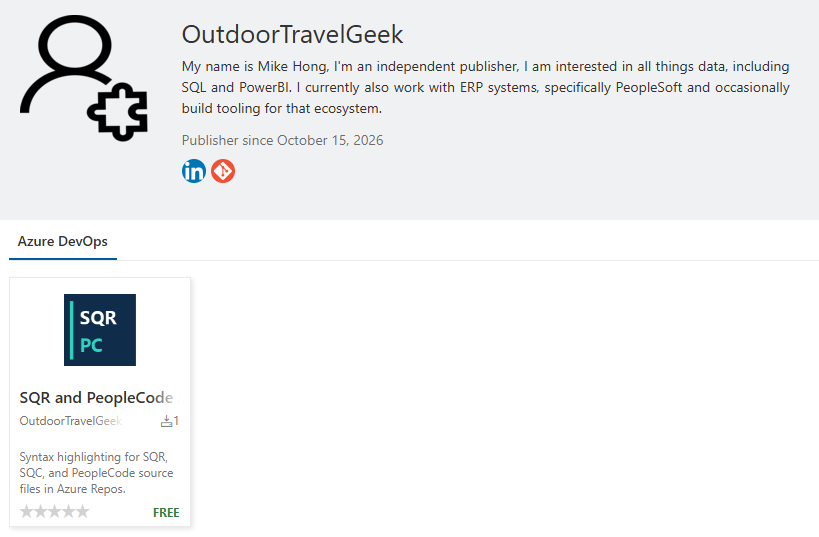
    So I published my first extension to the Microsoft Visual Studio Marketplace this morning. It’s an Azure DevOps extension that adds syntax highlighting for SQR and PeopleCode files, which is probably only interesting to a fairly small group of people who work with PeopleSoft. But I’m pretty happy with it, partly because it makes reviewing code a little easier, and partly because I went from an idea to a publicly available extension in a single morning.

    For those who don’t spend their days looking at source code, syntax highlighting is what gives different parts of a program different colors. Comments, keywords, strings and variables are easier to pick out when you’re reading through a file. It’s something you get used to having in a code editor, and you notice pretty quickly when it’s missing. I wanted that for SQR and PeopleCode in Azure DevOps, so I figured I’d see whether Codex could help me put something together.

    To be honest, without AI I probably would never have bothered. I’d have needed to learn how Azure DevOps extensions work, figure out how to define the highlighting rules, learn how to package the extension, and then work through the whole publisher registration process. None of that is beyond me, but it’s a fair amount of time to spend just to get some colors in a code review. It’s the sort of thing I’d think would be nice to have and then never actually get around to doing.

    I gave Codex a link to Microsoft’s extension documentation, an existing Marketplace extension that did something similar for another language, and a couple of GitHub repositories with SQR and PeopleCode support for VS Code. From there it worked through the extension format and created the code, build scripts, documentation and tests. Apparently the VS Code highlighting definitions couldn’t just be dropped into an Azure DevOps extension, so there was some work involved in creating the right definitions. Thankfully I didn’t have to spend the morning figuring that part out myself.

    There was a little back and forth as I worked through the release process. I registered as a publisher under outdoortravelgeek, updated the publisher setting, and had Codex rebuild the package. One useful thing it caught was that I’d edited a generated manifest, so my change would have been overwritten the next time I built it. Once that was sorted out I installed the extension in Azure DevOps and tried it. It worked well, so I asked Codex to set it to public and create a new version, which I then published to the Marketplace. The project also has 17 passing automated tests, though seeing it actually work in Azure DevOps was the part I was most interested in.

    I guess this is what people mean by vibe coding. I described what I wanted, gave it some references, and worked through the results with it. I still went through the registration and publishing steps and tested what it produced, but having help with the unfamiliar parts made the whole thing easy enough to finish while I was still interested in doing it. By the end of the morning I had a publisher account and an extension that other people could install.

    Anyways, if you work with SQR or PeopleCode in Azure DevOps, hopefully you’ll find it useful. It’s a pretty small contribution to the world of software, but it’s my first published Marketplace extension, and I’m glad I finally made one. There are probably a lot more little projects like this that I’d actually get around to doing now.

  • Smarter SMART with AI

    I posted this article on my LinkedIn profile recently. I used to think moving into management meant giving up the part of my career I loved most, building cool things. Over time, I realized leadership is just another form of building. And surprisingly, AI has become one of the tools that’s helped me make that transition. Here’s what I learned…

    Smarter SMART with AI, and Finding Joy in Helping Others Build

    One of the greatest privileges of my career has been occupying a unique space within technology organizations: being trusted enough by CIOs, CTOs, COOs, directors and executive leadership to help shape modernization strategy, while still remaining close enough to the work to personally build and deliver solutions.

    There’s something deeply satisfying about taking an idea from a whiteboard discussion to a proof of concept, evolving it into a minimum viable product, and ultimately deploying it into production where people rely on it every day. Watching an idea become a real solution has always felt like a win.

    Over the past decade, I’ve been fortunate to help lead and deliver several initiatives that began as executive conversations and ultimately became enterprise solutions. These include modernizing the California Department of Education’s DataQuest reporting platform, modernizing data platforms for the San Diego County Employees Retirement Association and the California Department of Managed Health Care, and developing a legal document search platform for the DMHC. Each started with a vision presented to executive leadership, and I had the opportunity to help execute that vision from concept through production.

    For many years I hesitated to pursue higher leadership positions because I knew it would mean fewer opportunities to build software and more time spent in meetings, planning sessions, budgets, and personnel management. I’ve always loved learning new technologies and creating systems that solve real problems. As my responsibilities grew, I had to accept that my role would gradually shift from being the primary builder to enabling others to build.

    That transition changed my perspective on management.

    Performance evaluations, for example, can easily become a compliance exercise. This is especially true in unionized environments where ratings often have little direct impact on compensation. (But that is a spiel for another day). Rather than viewing them as another administrative requirement, I wanted them to become meaningful conversations grounded in measurable accomplishments and focused on future growth. I also wanted employee goals to truly be SMART: specific, measurable, achievable, relevant, and time-bound.

    The challenge was measurement.

    Over the past year, one of my team’s modernization efforts has been implementing a contemporary project management platform, documentation repository, and source code management environment. While this created a wealth of operational data, transforming that information into meaningful insights remained difficult.

    This is where AI, specifically ChatGPT Codex, became an unexpected leadership tool. Using Codex, I quickly developed reports that summarized project contributions, technical accomplishments, documentation, and development activity. Those reports provided objective evidence that helped me write more thoughtful performance evaluations and establish meaningful SMART goals for each team member.

    Out of curiosity, I even experimented with having AI draft entire evaluations. Technically, it worked remarkably well. It populated our PDF evaluation forms correctly. But something was missing. It didn’t sound like me. Technology can summarize accomplishments, identify patterns, and save hours of administrative work. What it can’t replace is the human understanding of a person’s growth, character, resilience, and potential.

    In the end, AI didn’t replace my judgment, it amplified it. By reducing the time spent gathering evidence, it allowed me to spend more time on the part that actually matters: recognizing achievements, providing meaningful feedback, and helping people grow.

    Looking back, I realize that my definition of “building” has changed.

    Earlier in my career, the greatest satisfaction came from delivering production systems. Today, I still enjoy creating solutions, but I find equal satisfaction in helping shape strategy, equipping my team with better tools, and watching them deliver outstanding work.

    Perhaps that’s one of the more rewarding transitions in leadership: realizing that success is no longer measured only by what you build yourself, but by what you enable others to build.

  • the eulogy

    My dad passed away recently, and his memorial service was this weekend. I am grateful to have had my dad as a father, hopefully the tribute I wrote and read to him does his memory justice.


    Hi everyone, for those that don’t know me, my name is Mike Hong, and I am Seung Hong’s elder son. Thank you all for coming to this memorial service to remember my dad and celebrate his life. 

    There is a Korean phrase 부모 잘 만났다. Literally translated it means it’s good you met your parents, or you are lucky to have met your parents. I always thought that was kind of a weird saying, after all we don’t really remember meeting our parents, our memories really don’t go back that far to the day we’re born. But I will say that I am lucky to have the dad that I had, and I am sure there are many people who would say that they are lucky to have met my dad. 

    To many people who met my dad, my dad was their handyman of choice. It seemed like he could fix anything. Whether there were house problems, car problems, or broken appliances, my dad fixed them all. When my dad first immigrated to the United States he bought an appliance repair company. That didn’t really work out that well, so he found a job working for the city of San Francisco, first working for the City College of San Francisco as a stationary engineer, and eventually rising to chief engineer of a San Francisco Fire Department pumping station. Even while working full time for the city, he worked on the side repairing appliances for many Korean businesses. He was a hero to the Korean community in San Francisco, repairing deli shop refrigerators, restaurant walk in coolers and doughnut shop mixers for many Korean businesses in the SF bay area. 

    This sounds like the kind of dad who wouldn’t have time for his family, but nothing could be further from the truth. My dad was always the dad who volunteered to drive on school field trips and show up to kids sports games, even helping to coach some teams. Somehow he was able to arrange his schedule so that he could drop off or pick up from school when we needed a ride. And there were many afternoons after school where we went to the park to play tennis or basketball with my dad. I have many fond memories of trips to Tahoe to ski in winter and camp near a hot spring in summer. And whenever any relatives visited from Korea my dad was the consummate host, showing off the beauty of this land America we lived in by taking the family on long road trips to national parks like Yosemite, Yellowstone or Crater Lake. Even after my brother and I were adults he would always be available to help us fix anything in our car or in our house that needed repair. In short my brother and I were lucky to have my dad because he was the dad who seemed to always be available. 

    My dad retired from working with the city relatively early and continued working as a stationary engineer in San Francisco, working for various companies like the Holiday Inn hotel and Standard Sheet Metal. After he retired for the final time and especially after my brother got married my dad focused a lot of his time on fixing me. He encouraged me to finish my schooling and go back for an MBA, but mostly he focused on making sure I got married, setting me up on blind dates. He kinda even bribed me to go, giving money to spend on these dates. I didn’t really take it seriously at the time, so I almost made a game of how little I could spend. After he exhausted his network he even went to the point of signing me up for a Korean dating site, I didn’t learn until later that it cost thousands of dollars.

    I know he was extremely happy when out of the blue I told him that I was planning to get married, and was extremely happy to have met my then fiance Go Eun. We went on a Christmas trip with Go Eun’s family to Las Vegas in 2021 and not long afterwards my dad suffered a severe stroke, just the day before New Years eve in 2021. From that point on my dad was paralyzed on his left side, and had to be on a feeding tube. As we were transitioning him down to Southern California to be closer to where my brother and I had moved, he moved through several different ERs and nursing homes. This was during the Covid pandemic when it was difficult to visit him, and during one of the nursing home stays he caught Covid and pneumonia. He was put on a ventilator, and while he eventually recovered from Covid and pneumonia his condition grew worse. He eventually moved home with my mom as primary caregiver, and he lived mostly bed-ridden until he passed on January 12, 2026. I wish my dad had more time to spend with Go Eun and with Joey, my son. I know he would have been a great father in law and an awesome grandfather to them. 

    For much of my life my dad prided himself on being the strong fixer that others came to for help. My dad seemed to be able to fix anything, but he could not fix the frailty and weakness that comes from being human. He had heard the gospel from various family members and friends but never believed. It was not until after his stroke that my dad came to accept Christ. He heard the gospel from a Korean nurse during one of his ER stays. I am reminded of 2 Corinthians 12:9 that says “My grace is sufficient for you, for my power is made perfect in weakness.” And so because of the grace of God my dad heard the gospel from an unnamed nurse who I will forever be grateful to, and he accepted Christ as his savior. And I am also thankful for Pastor Frank who visited my dad during one of his ER stays and confirmed his salvation, and later visited him and prayed with my dad the day before his passing. 

    I am so thankful that because he accepted Christ we have hope that we can see my dad again in heaven. So I conclude with the last words my son Joey said to my dad– “See you halabuji…” I don’t know if it’s because my son is wiser than his years – probably not, he’s two, so he probably doesn’t yet understand the gospel. But yet somehow he picked the best possible farewell. So I will end with the same words. 

    “See you dad. Take care until we meet again in heaven.”

  • the toast

    So I got married. Here’s the thank you speech/toast from my wedding…

    As some of you may know we have been in a global pandemic for the past couple of years. For many people this was a life changing event. It was life changing for me as well. Before the pandemic I worked for the State for a dozen years. During the pandemic I switched jobs 4 times, only to end up back where I started, working for the State. I moved down to Southern California, after living in Northern California most of my life. And of course I met the love of my life. And like many people I had a lot of time on my hands. Being the introvert that I am, I had a lot of time to think. And so I wanted to share with you some of my thoughts.

    One thing I thought a lot about is the importance of family and friends. As some of you guys know my dad suffered a stroke late last year, and so he could not be here today. It is in hindsight that I wish that I had spent more time with my parents, and I wish I had said more often how much I appreciate them. I am so thankful to my parents for raising me, and to Go’s parents for raising the beautiful bride in front of you all. I am thankful to my brother T and his wife M for letting me crash at their place so many nights, first while I was trying to get settled down here, and later while I was dating Go. I am thankful for that time to get to know my niece N, our cute flower girl, and J who would have been our ring bearer if he had been able to walk a little better. And thank you J for being a loving sister to Go. I am hoping to get to know you better as a sister in law.

    When I lived in Northern California, we had all our Socal family who we saw maybe a couple of times a decade, all our aunts and uncles and cousins. I’m thankful that I’m now closer and we’re able to see each other more often. Special thanks to M, one of the cousins who I used to only see a few times a decade, for being our officiant. And a special thank you to all of Go’s aunts and uncle who flew in from Korea to be here to celebrate with us today.

    Moving to San Diego during the pandemic started off kind of lonely. I am thankful for my friends S and P, who are two of my groomsmen for helping me get settled in San Diego, and to V, my other groomsman and last but not least my best man T, for visiting me during those lonely times. And thank you to Go’s bridesmaids L, M, and N for being a huge part of Go Eun’s life through both school and church. And thank you to all the other friends who are here, thanks for all the memories we’ve shared, fellowshiping, and eating, traveling, and adventuring together.

    Since I read our vows for the first time, I’ve been thinking about the concept of ‘for better or for worse.’ I’ve come to realize that family and friends are the people who are there to celebrate with you through the better times, and help you through the worse times with advice or even just a shoulder to cry on.

    One other thing I thought a lot about during the pandemic was the past, present, and future. All of you are a part of Go and my past, and by being here you are all a part of our present. And we hope that we continue to be in each other’s lives in the future.

    And so in closing I wanted to toast those few thoughts–

    To family and friends, for better or for worse, and to past, present, and future, cheers!

  • post of panoramic photos

    post of panoramic photos

    I miss traveling.

    I especially miss wandering around the world with my camera. One thing that I would often do on my trips is take a panoramic photo of a spot that was especially memorable or scenic. Thankfully I posted most of these on either Facebook or Google photos with a pretty verbose description of the scene. So while I can’t travel right now due to the COVID pandemic, I can relive some of those travel memories.

    I thought that I’d share some of those panoramic photos and their associated memories here.


    2/17/2020 View of Busan from the top of Baesan.

    My most recent trip overseas was to Korea in February of 2020. (Gosh has it already been a year?!)

    I arrived in Korea just as the COVID pandemic was starting to explode in the province of Korea that I was heading to. The COVID pandemic had already affected my travel plans — originally I was supposed to meet friends in Chongqing, China, but those plans were scrapped as my friends were frantically trying to figure out how to leave China as what later came to be known as COVID-19 raged through Wuhan in the neighboring province. Instead of going to China I flew directly to Korea. I actually didn’t have a choice in the matter, my stopover flight to China was cancelled and re-booked into a direct flight to Korea by the airline. I was wary of getting on public transportation, so I decided that I’d cross off a bucket list item of mine and ride my bicycle across Korea, from the northwestern city of Seoul to the southeastern city of Busan.

    This photo was taken after I had arrived in Busan, I decided to go for a hike to a nearby mountain to get the blood flowing in my legs to help me recover from the ride.


    8/16/2019 View of Interlaken from the top of the Harder Kulm in Switzerland

    In fall of 2019 I bought a two week Eurail pass and traveled through France, Switzerland, Austria and Italy. I had always wanted to go hiking and biking in the Alps. I knew there would be amazing scenery, but I was still blown away by how beautiful the towns were.

    The highlights were the view from the top of the Harder Kulm (seen here) and renting a bike and riding through the beautiful valley of Lauterbrunnen and gawking at the waterfalls streaming down the cliffs into the valley. I actually able to accomplish both on the same day, but only because I cheated and took the cable car to the top of the Harder Kulm instead of hiking (and I rented an e-bike to ride into Lauterbrunnen). I did at least hike down though…


    3/24/2019 Sunrise at Glacier Point

    Ever since my first snow backpacking trip in Yosemite to Dewey Point it’s been on my bucket list to make the longer, more difficult hike to Glacier Point to see the sunrise over a snowy Yosemite valley. I finally was able to make it out there in spring of 2019 with my buddy Vishal. It snowed really hard on our way in, and we spent the night in freezing cold tents to experience the warm glow of the sunrise over the valley. It was a once in a lifetime experience, seriously, because I’m not gonna do that 20 mile trek in snowshoes again…


    5/4/2018 Taipei from the top of the Xiangshan hiking trail

    In 2018 I traveled to Korea with my parents. On our way to Korea we stopped over in Taipei for a few days. It was my first time traveling overseas with my parents since I was a kid and I was worried that it would be awkward and that I wouldn’t be able to enjoy the freedom I normally enjoy when I travel. I was especially worried that they wouldn’t be able to do this hike up Xiangshan that I wanted to do.

    It wasn’t an easy hike since there was a lot of elevation gain, but they were troopers and we made it to the top. It had rained the day before so I was worried that it would be overcast, but instead we got lucky and were treated to a gorgeous view of the city from the top.


    7/3/2017 Moraine Lake in Banff National Park

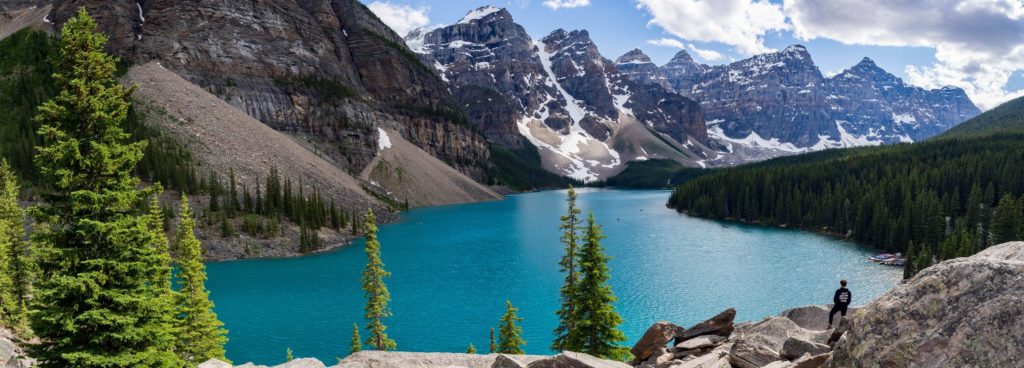
    In 2017 I saw a news article that said Canada would be celebrating its 150th anniversary and as part of the celebration they’d be giving out national park passes. My buddy Tim and I flew out to Calgary, rented a car, and road tripped through Banff, Jasper, Glacier, and Revelstoke. The Canadian national parks did not disappoint. Lake Louise and Moraine Lake (pictured here) are some of the most beautiful lakes I’ve ever seen.

    But sometimes it’s the unplanned and unexpected moments that you remember most. We ended up in a tiny town called Golden for the 150th anniversary celebration, sitting on the banks of a river watching the fireworks. I guess because the town was so small we essentially had front row seats, and even though the town was so small the fireworks were huge.


    2/17/2017 View of Dubrovnik from the trail to Fort Imperial

    In early 2017 I traveled to eastern Europe. I flew into Vienna, Austria and took trains through Ljublana, Slovenia to Zagreb, Croatia. From Zagreb I rented a car and drove across all of Croatia to Dubrovnik. Since it was a one way car rental I rented the cheapest car I could find, a tiny Skoda hatchback, but it was still expensive. But the car gave me freedom, and it allowed me to meet up with my cousin’s family who were traveling through eastern Europe on a Korean package tour. Dubrovnik is an amazingly beautiful city, and the fortress walls were cool, but hiking up to Fort Imperial and seeing the walls of Dubrovnik from above was even better.


    9/19/2015 View from Mather Pass on the John Muir Trail

    In fall of 2015 I hiked about half of the John Muir Trail with my friend Tao. He had permits for the entire trail, and started in Yosemite. I met him at Muir Trail Ranch, one of his resupply points about a hundred miles south of Yosemite. My first few days on the trail were rough. Having spent a week on the trail already, Tao was already acclimated to the altitude and daily mileage but I was struggling due to the altitude.

    Each day we’d wake up super early, and get over a mountain pass and hike back down into a valley. The first couple of passes were at about 10,000 feet. They progressively got tougher. Mather Pass was I think the 3rd one I had to get over, and I was just about reaching my breaking point. The pass was 12,100 feet and it felt like a ridiculously long and painful grind to get to the top of it. I don’t swear all that much, but I remember distinctly thinking, “What the FUCK am I doing here?!” as I looked around from the top of the pass and saw nothing but mountains in every direction. Even if I wanted to quit and give up on the idea of hiking the JMT I would need to get over at least one of these 12,000 foot passes to even get out of here.

    It’s a funny thing though, once I resolved myself to my fate it didn’t seem quite as bad. Over the next few days we’d get over 3 more of these passes — Pinchot Pass, Glenn Pass, and Kaersarge Pass. All of them were hard but towards the end the altitude acclimation kicked in I guess so I was actually able to enjoy the hike.

  • fits and starts and screenshots

    fits and starts and screenshots

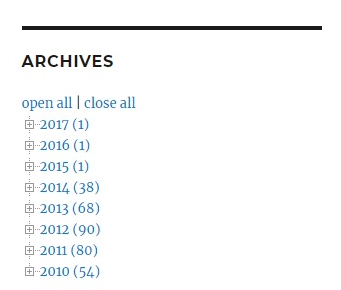
    It’s been a while since I’ve been on here. As you can see from the screenshot below my last post was in 2017, and it’s been a half dozen years since I’ve posted more than once a year.

    I’ve attempted to restart this blog several times in the past few years. There are actually a couple of drafts from the past few years, but for whatever reason I was too lazy to finish writing a post. But with the COVID-19 pandemic in full force and with a lot of time on my hands, I decided there’s no better time to start writing again. And since I can’t travel I thought I’d try and look through my notes and photo albums to see if I could backfill this blog with content from those missing years.

    During the past half dozen years I’ve been fortunate to have been able to cross some major items off my bucket list including:

    • Riding my bicycle across Korea (finally wrote this one up)
    • Snow camping at Glacier Point (published this one as well)
    • Backpacking the John Muir Trail (most of it. okay like half of it.) I had actually planned to write about my journey on the JMT, but somehow only managed to write about the plan
    • Scuba diving the Great Barrier Reef
    • Driving the Icelandic Ring Road
    • Road tripping through Canadian National Parks during Canada’s 150th anniversary year
    • Driving across the beautiful country of Croatia from Zagreb to Dubrovnik

    Hopefully I’ll write about those trips soon, along with some random updates and thoughts I’ve had. I’m hoping that seeing this screenshot with no content from 2017 onwards and only one post each from 2015-2017 on the front page will be motivation for me to start writing again.

  • dating data reporting

    I’ve been working in the Data Reporting Office of the California Department of Education for about a year now. The logical and analytical left brain part of me enjoys the challenge of writing SQL statements (SQL is a database programming language) to extract the data needed for reports. The end result of my work is mostly reports filled with numbers. It actually sounds kind of boring when I describe it this way.

    In general I like to do things that tell stories. I think that’s the creative right brain part of me. I like to take photographs and write on this blog, both of which are inherently methods of story telling. I think that’s why after a year in my job I’m still not bored– My work requires logic, but it also tells a story, albeit in a slightly different way. The numbers in the reports I generate tell the story about the successes and failures of education in California. For example, there’s a lot of interest in English learner students in California, and a data set I worked with recently seems to tell the story about how our state is failing to educate these kids– many of them never achieve English fluency.

    On a completely unrelated note, it seems like there’s a lot of interest in my dating life (or actually the lack thereof). So I’ll try to tell the story of it. Unfortunately the usual modes of story telling don’t apply here. I don’t really have any interesting anecdotes to write about, and I don’t take pictures on dates (that would be awkward). But I’ve been on my fair share of first dates, so I suppose there’s enough data and numbers to tell some sort of story about my successes or failures. So that’s what I’ll do. I’ll try write down any statistics I could think of– hopefully at the very least it’s an interesting story.

    Let’s start with some big picture numbers. I’ll start with cost, since that one’s easy. I am currently on 4 dating apps– Match, eHarmony, Coffee Meets Bagel, and okCupid. Coffee Meets Bagel has costed me the least amount of money, a grand total of ZERO dollars. okCupid is free too, but I spent $9.99 for one month of their premium service, mostly out of curiosity, which I’ll explain later on. For both Match and eHarmony I’ve spent about $240 each. Interestingly enough I started both of them about the same time and I initially bought a six month subscription with each of them for around $120. I forgot to cancel both of them, and now I am about a third of the way through my second six month subscription with both. The total cost for each has worked out to about $20 per month.

    In terms of bang for the buck, Coffee Meets Bagel (I’ll call it CMB since I’m tired of typing it out) has been the best for me. (That’s kind of a misnomer– there’s not actually any banging going on, neither literally or metaphorically.) CMB costs the least amount of money yet it has gotten me the most connections. The way CMB works is that you are matched with one profile every day, which you can either like or pass. If your match likes you as well, you are connected and can communicate through their messaging system. On a typical month I seem to connect with two or three matches, though not all of them will lead to first dates.

    Next in effectiveness for me has been eHarmony. Like with CMB there’s some sort of matching algorithm which selects profiles for you to see. It’s slightly less structured than CMB because instead of needing a mutual like to initiate communication, either side can start the conversation by sending questions. In eight months I’ve gone on three dates matched through eHarmony.

    I’ve had little to no success with Match and okCupid, mostly because of apathy on my part. With Match and okCupid you browse profiles and send messages to the people you are interested in. I find that it doesn’t work well for me. It takes a lot of messages to get a response, and even when I do get a few messages going back and forth none have ended with a date. So lately I haven’t been using either of these apps much.

    Actually, now that I think about it, there’s an additional matching “app,” though it’s not a website and doesn’t exist on a smartphone. It’s my family. In terms of dates per dollar it’s actually the most effective, being the only one that’s actually been a financial gain. (My aunt in Korea actually gave me money to go on a blind date.) In terms of number of first dates it ranks pretty highly too, about on par with eHarmony.

    I’m not sure if my results are typical. I have friends who have had success with both Match and okCupid, so my results there are probably not typical. But I’ve heard from several friends that CMB seems to work well for them, and I know of several married couples who have met on eHarmony, so in general it seems like within my circle of friends I’m fairly in typical in leaning towards CMB and eHarmony. In terms of match rate or number of first dates I have no idea if my results are typical, though if I had to guess I’d say they’re probably lower than average. All of the dating apps have a way of selecting preferences for matches, and in these preferences I am very selective which most likely severely lowers the number of potential first dates.

    The reports I generate at work are typically aggregated or filtered based on several demographics– typically gender, race, age (or more likely grade), location (typically county or school district) and subgroup (typically these include demographic information like if a student is homeless or a foster child.) Similarly with these dating apps I filter my matches based on gender (females only please), race (Asian or Pacific Islander), age (25-35), location (typically just far enough to include the Bay Area) and subgroup (typically it’s Christian, never married, no kids currently, non smoker).

    I don’t have any hard data on this, but I’m fairly certain my stringent preferences shrink the potential number of first dates significantly. The only thing I have resembling a statistic comes from okCupid. I briefly mentioned earlier that I paid $10 for a month of premium on okCupid, which they call A-List. okCupid lets you ‘like’ a profile. You can see a list at any time of the profiles you’ve liked, every single one of them fit the demographics I mentioned earlier, i.e. Asian girl between the ages of 25-35. It also shows you mutual likes for free. At the time (this was several months ago) I had liked a few dozen profiles but had only a single mutual like. I had twenty people who had liked my profile. If you pay for A-list you can see who likes you, so out of curiosity I paid for one month. Something like 95% of the people who had liked me were either white, black or Latino, the one mutual like was the only Asian who had liked me. I guess that’s the (dating) story of my life. The girls I like are not interested in me, and the girls that like me are the ones I’m not interested in…

    Anyways, now we get to the heart of the report, the numbers. The numbers will basically be about whatever I feel like. Like my work reports the numbers will be broken down by demographics. We’ll ignore gender since they’re all female, race will mostly be either Korean or Chinese. I won’t report on age or subgroup (or like we say at work, that data is redacted). Location will basically be Sacramento or other. The numbers are mostly from memory so they may be off by one or two, and if you try to sum up the numbers you won’t get any meaningful result due to missing data (this often happens with work reports too), but hopefully the numbers tell an interesting story.

    Here we go.

    Out of 3 Korean girls that I met for first dates in the greater Sacramento area, 100% were through CMB. 100% were at purveyors of caffeine. Out of those, 2 were at Starbucks, 1 was at a boba place. Only 1 of those went beyond a first date, the 1 that was NOT Starbucks. Clearly Coffee Meets Bagel should not be taken literally…

    Out of 4 Korean girls that I met for first dates outside of the greater Sacramento area but within the US, 25% were from CMB, 25% were from eHarmony and 50% were from family. One date was at a purveyor of caffeine (Starbucks). Out of the original 4 a total of 50% forgot to bring their wallet. Out of those that forgot to bring their wallet I thought 100% of them were really cute. Sadly out of those cute forgetful girls 0% went past a first date.

    Out of 4 Chinese girls that I met for first dates outside of the greater Sacramento area 50% were from eHarmony and 50% from CMB. 0% forgot to bring their wallet. Out of the original 4 a total of 50% were grad students at UC Berkeley. Out of the original 4 a total of 50% of the time I went on the first date with a bicycle on my car. Out of those I actually only rode my bicycle on the date 50% of the time. Out of the original 4 only 1 was at a purveyor of caffeine (Philz!)

    Out of 2 Chinese girls and 1 Japanese girl I met in the greater Sacramento area 100% were through CMB. 100% were in the medical field yet 0% were doctors. Two were at purveyors of caffeine and one was at a purveyor of beer (is there anything to do in Sac for a first date besides coffee or beer?) 0% forgot to bring their wallet.

    Out of 7 blind dates that my family has tried to set me up on, 100% have been Korean. Three of them were located in Korea, two were in California, one in New York, and one in Seattle. I have gone on 100% of the ones in California, 33% of the ones in Korea, and 0% of the ones in Seattle and New York.

    The farthest date from home was the one in Korea, over 5,000 miles away, which was organized by family. The farthest that was not organized by family was nearly 2,400 miles away in Washington DC, initially met through eHarmony.

    The most expensive date I can remember was nearly $200, though that wasn’t a first date. It consisted of dinner and musical tickets. The most expensive first date I can remember was around $20, which was two cheap entrees at a Chinese restaurant. The cheapest first date was closer to $2, one small coffee at Starbucks for myself (she paid for her own, obviously she didn’t forget her wallet). Maybe I shouldn’t cheap out so much on first dates…

    If I tried harder I could probably come up with more statistics, but I’ll stop here. In hindsight my dating life isn’t all that interesting, maybe someday I’ll have an interesting anecdote to share instead of these boring numbers.
  • the plan

    The plan, if it can really be called that. When I actually type it out it does sound kinda crazy…
     
    • Ride Uber or Lyft from my house to the Sac Airport.
    • Rent car at the airport and drive 250 miles to Florence Lake.
    • Take ferry and hike (or just hike if ferry is closed due to low water) 11 miles to Muir Trail Ranch.
    • Hand keys to my rental car to two guys (who I still actually haven’t met in person) who will drive it back to Sac Airport.
    • Hike on the John Muir Trail approximately 110 miles from Muir Trail ranch to Whitney Portal.
     
    That’s the part I had signed on for, because I thought I had a ride from Whitney Portal back to my house. But that ride seems to not be a possibility anymore. So now in addition to the above I’ll need to:
     
    • Hitchhike or hike 11 miles from Whitney Portal to Lone Pine.
    • Ride the Eastern Sierra Transit Authority bus from Lone Pine to Reno.
    • Take Amtrak or Greyhound bus from Reno to Sacramento.

    For some reason it’s the second portion of this that’s giving me second thoughts. That’s crazy huh…


  • the POST finale

    Today was my last day with the California Commission on Peace Officer Standards and Training, or POST as it’s known internally. On Monday I’ll be starting a new job at the California Department of Education.

    My final day at POST was like most endings in my life so far– anticlimactic. I spent the early part of the day filling out my exit paperwork, then I spent a few hours wandering around shaking hands and saying goodbye to the people I’ve worked with. That’s probably what I’ll miss most about this job, the people. Because it’s such a small organization it’s almost like an extended family.

    The work itself I won’t miss too much– Initially I really enjoyed it, and it was something that I wanted to try my hand at. I was hired on as a web developer, and because the agency is pretty small I was able to do a variety of things as a web developer, from graphics design to database administration to programming and even some photography. At least that’s how it was initially. But towards the end of my time there I was almost a pure programmer/developer, which I found I didn’t enjoy as much. I found that I enjoyed working with databases, and so I’m fortunate that I was able to find a job that works with data more. Starting on Monday I’ll be working in the data reporting office of the CA Department of Education.

    I’m fortunate that I found a new boss that was willing to take a chance on hiring me as a database/report developer, even though I don’t have a whole lot of experience with databases or data reporting. And I’m fortunate that four years ago I found a boss that was willing to take a chance on hiring me even though I didn’t have a whole lot of experience in web development. Looking back I realize that I’ve been blessed in my career– I’ve always been blessed with great managers, and I’ve always been blessed in being able to find a job in something that interests me, even though I might not have all the qualifications on paper. I’ve found that what I like most is learning, and I’m lucky that every job I’ve had has been a great learning experience, even though sometimes I learn what I don’t like doing.

  • korean market meals

    korean market meals

    One of my favorite things to do while traveling is to wander around the local markets and sample as much food as I can. Korea in particular was an amazing market meal experience for me, partly because I know and love the food. Much of the stuff in these markets I can find in America, but I found that everything was so much tastier here.

    Photos

    In Seoul there’s the Namdaemun market. I spent the better part of a day eating my way through this market. The first thing I had there was the ddeokbokki, which is rice cakes stir fried in spicy sauce. The ddeokbokki was okay, but the best part of this meal was the bit of fish cake soup that came with it. All together it was super filling for less than $3. In hindsight though, I wish I had eaten less of it so that I would have room for other stuff later.

    kimchee dumpling. awesome.

    These kimchi dumplings were ten for 5000 won. I didn’t have room in my belly for ten of them, so I asked for one, and they charged me 1000 won. In hindsight I should’ve just bought the ten, and saved them for later because they were incredibly good. It was a revelation to me, how good these could be when fresh, because I’ve only had the frozen ones before.

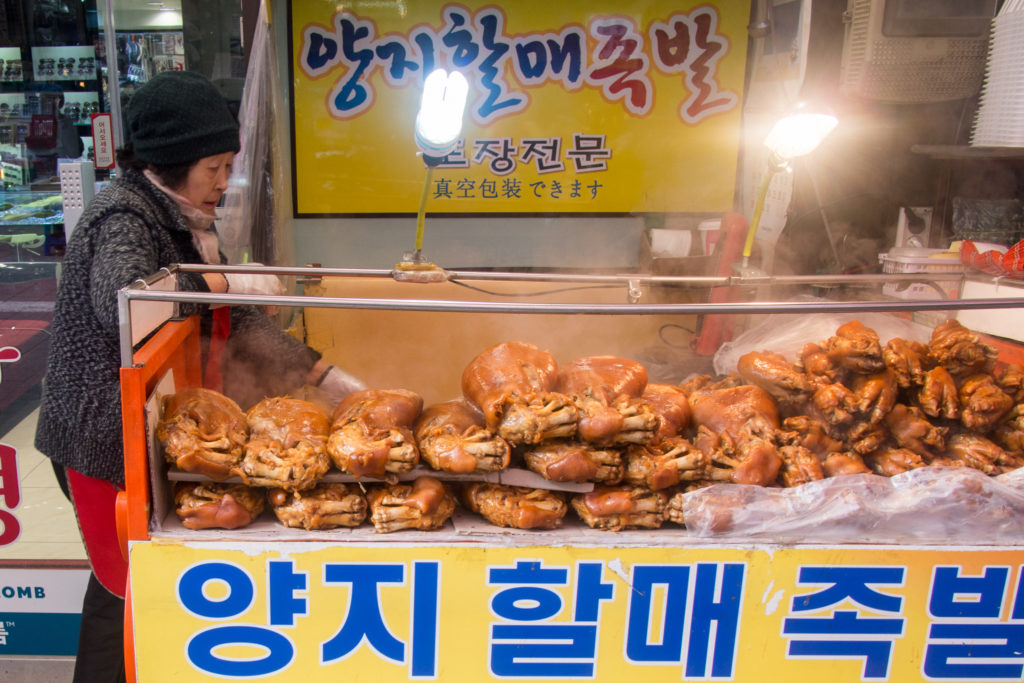
    grandma's pig feet, with legit grandma.

    Grandma’s pig feet stall, complete with a legit grandma. I’m a big fan of pig’s feet, and it’s been a while since I’ve had one, so this was really satisfying to me. Apparently it’s pretty popular in Seoul, since I saw a lot of pig’s feet restaurants and stalls in Seoul.

    OLYMPUS DIGITAL CAMERA

    In the heart of the Namdaemun market there’s a tiny hole in the wall restaurant that specializes in kal-gook-su. Literally translated it means knife noodles. I eat these noodles from time to time in America, but I’m pretty sure the noodles are store bought and made by machine. This place still makes them and cuts them with a knife by hand. It was super tasty, for the equivalent of about $4 you get all this food, a huge bowl of kal-gook-su, a bowl of spicy naengmyun (cold noodles) and a bowl of barley rice.

    Photos2

    In Busan I went to the famous Jagalchi market with my nephew to grab lunch. There are some foods there that I didn’t see in the Seoul markets. They had spicy pig skin, sunji soup (sunji is coagulated cow’s blood), and gamja-tang (literally translated this is potato soup, traditionally it’s made with pig spine). My nephew and I split a bowl of sunji soup. Typically I’m not a fan of food made with blood, but this was quite tasty. The lady was super nice too, she refilled our bowl for us, even though we were splitting a 3500 won bowl (equivalent of about $3). In hindsight I wish I had some of the gamja-tang too, since I like that stuff. I figure if something I don’t typically like tastes good here, stuff that I normally like should taste incredibly awesome. Unfortunately I didn’t have enough stomach space.

    Photos

    Jagalchi market is famous for seafood. There are literally seafood stalls as far as the eye can sea. It’s all super fresh, and much of it is still alive. Many of the stalls had little restaurants in the back, so you can pick out the seafood and they’ll make you a meal right on the spot. You could get the famous live octopus here. I was planning to eat it here, but I chickened out at the last minute when I saw how lively they were.

    Photos3

    My nephew and spent some time just wandering through the Jagalchi market looking at the various fish for sale. We were pretty full, so we weren’t planning to eat anything. All of a sudden I heard this lady yelling (in Korean), “If it’s not good I won’t take the money.” So I stopped to take a look at the fish her husband was grilling. It certainly smelled good.

    Before I knew it, this lady started dragging me and my nephew into the little restaurant behind the stall. So I’m thinking okay, I’ll order just one piece of fish, just to try it. But they said the minimum I could order was a meal for two people. So at this point I’m thinking, “Dammit I’m about to get ripped off, this is gonna be really expensive and probably isn’t gonna be very good.”

    So we proceed to order the minimum for two people, which ended up being 20,000 won (about $18). At this point, I’m thinking “Shit, I just got ripped off really badly.” But then as my nephew and I start eating, we find that the fish is super tasty, and the meal came with a lot of side dishes and a bowl of miyuk gook (seaweed soup) that’s also quite good. And by the time we’re done eating, the little restaurant was completely full. Whether it’s from people that the lady dragged in, I’m not sure, but everyone in the place seemed very happy to be there. And in the end I was pretty happy too. I left with a smile on my face, so when I asked the lady if I could take a picture of her, she was all smiles too.

    Photos4

    I enjoyed everything I ate at the Jagalchi market so much that I ended up returning to the market. My main mission at the market the second time around was to eat some raw fish. There’s a section of the market where there’s a ton of hwae-jib (raw fish houses) lined up one after another. How do you pick which one to go to in this situation? I ended up going into one that seemed to have a good number of customers and ordered hwae-dub-bap, which is basically the Korean version of chirashi, raw fish over rice. The fish is incredibly fresh, they chop it up right there in front of the stall, and it comes with a few other seafood side dishes.

    Almost all of the meals that I ate alone in Korea was at the markets. There was so much tasty stuff, sadly I just didn’t have the stomach capacity to eat everything I wanted to try. And one thing I liked was that each market seemed to have its own regional specialties. If I ever get a chance to spend a good block of time in Korea, I’d like to just travel around the country and eat at a market in each town along the way.

  • angkor within the frame

    angkor within the frame

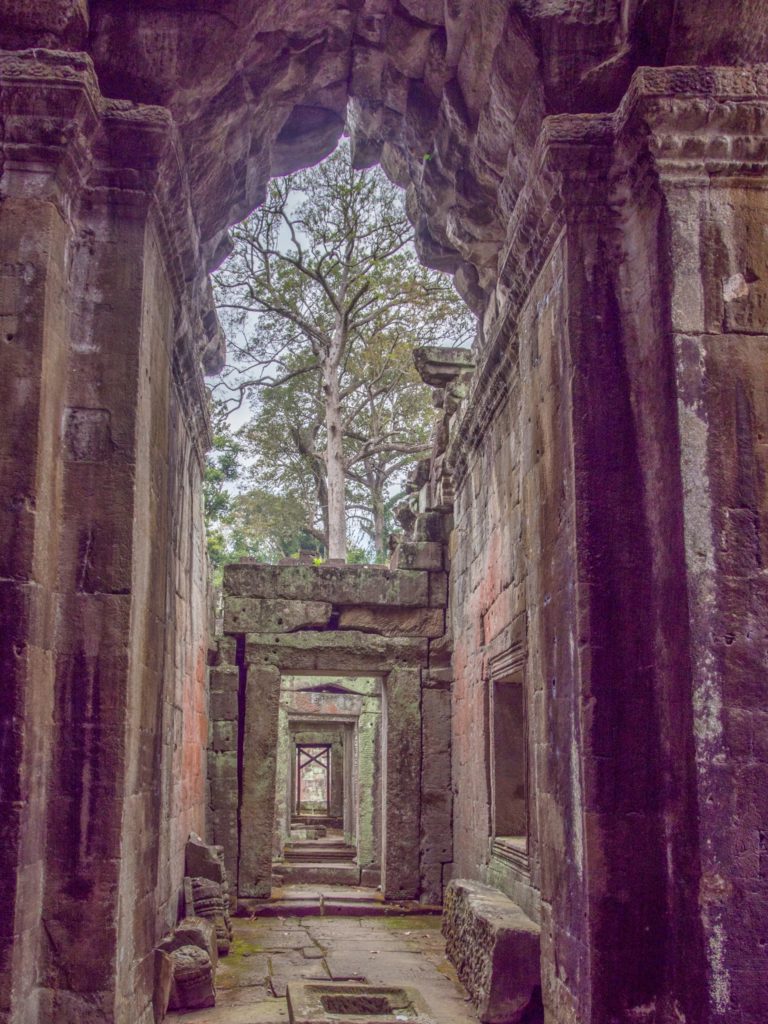
    When taking pictures at a place like Angkor Wat it’s very easy for all your pictures to start looking pretty similar. So to try and make things a little different from usual I took a lot of pictures that were framed by doorways or columns. Here are some of them.

    towers in columns

    Two towers of Angkor Wat framed by columns.

    the view from the top

    The view from the top of Angkor Wat.

    steep steps up (i think it was bakong)

    Steep steps to the top of the temple.

    buddha

    Many of the temples had a Buddha shrine in the center.

    face in a frame

    One of the many faces of Ta Prohm.

    OLYMPUS DIGITAL CAMERAThere are many parts of the temple where the roots of a tree grow over the stone wall. Ta Prohm is especially famous for this.

    tree framed by doorway.

    Sometimes an entire tree will grow into the stone roof.

    monkey guardian in a an intricately carved door frame

    One of many monkey guard statues at Banteay Srei. The door frames are very intricately carved at Banteay Srei, they’re actually more detailed than the statues.

    frame within a frameFrames within frames.

    fallen blocks

    Many sections of the temples within the Angkor Wat complex had caved in. What’s amazing is that they’re still open to the public. In America something like this would probably be closed to the public.

    When I opened up my pictures from Cambodia in Lightroom, I found that I had almost 500 images. Many of them look pretty similar to each other. Framing my shots with a frame in the image helped to alleviate the monotony a bit. I found that shooting like that made it hard to get an acceptable exposure, because typically one side of the frame would be indoors and the other would be outdoors. It shows in these pictures that my camera’s dynamic range was stretched. My little Olympus OM-D camera gives up almost two stops of dynamic range to my previous Pentax K-5 camera. In most instances I don’t miss those two stops (and don’t miss lugging around an SLR), but in situations like this I sometimes miss having a camera with a larger sensor.

    My dream camera at this point would be the recently announced Sony A7 II (I know my dream camera seems to change on a daily basis…) That Sony mirrorless camera seems to be the best of both worlds, a large sensor with great image quality, but still fairly compact, the only downside is the price. The lens and camera combination I’d want would be almost $2500. That’s more than I spent on my entire month of traveling, so yeah, I’ll probably stick with my OM-D for now.

  • candid cambodia

    candid cambodia

    One thing that’s great about travel is that it takes you out of you comfort zone. Physically you’re out of your comfort zone, but also photographically travel takes me out of my comfort zone. I would say I’m more of a landscape/outdoor photographer, but traveling lets me take photos that I wouldn’t normally take. I’m not usually much of a people photographer, but something about travelling makes me more of a people watcher, so I decided to try my hand at people photography.

    watercolor artist at work

    One thing that impressed me about Cambodia was all the artists. Every market in Cambodia had artwork for sale, and a lot of it was very impressive.

    leather work

    There’s also a lot of artisans, and they seem to start at a very young age, like this boy working with leather.

    OLYMPUS DIGITAL CAMERA

    Sadly there are many people who were injured from land mines. At several places around the Angkor temple complex you can hear bands formed from people handicapped by mines.

    resting in the shadeSometimes you take a picture that you think tells one story, but find later that the story is completely different. I took this picture of what I thought was a guy relaxing alone with his guide book at the top of the temple steps. It wasn’t until I got home and saw the picture on my computer monitor that I saw the crutches.

    OLYMPUS DIGITAL CAMERA

    I’m not sure what the story is behind these kids. At several of the temples I saw kids playing alone. I didn’t see any parents, and they weren’t begging for money, they were oblivious to all the tourists around them.

    OLYMPUS DIGITAL CAMERA

    There were also many kids selling souvenirs. They were obviously not oblivious to tourists. They would literally follow you all the way back to your tuk tuk. I felt bad for this one (partly cuz I took her picture while she was following me) so I bought some post cards from her. Later on at our hotel I saw a flyer that explained why we shouldn’t buy from these kids.

    buddhist ascetism aint what it used to be

    Possibly because many of the Angkor temples are Buddhist there seemed to be a lot of monks around. To me it’s a bit strange to see a monk with a tablet and a cellphone is in his hand. Buddhist asceticism isn’t what it used to be.

    freshly blended fruit shakes

    At the night markets there are a lot of fruit shake stalls that will blend you a shake for a $1. They have Jamba Juice beat on price and taste, and it was especially refreshing in the warm and humid climate in Cambodia.

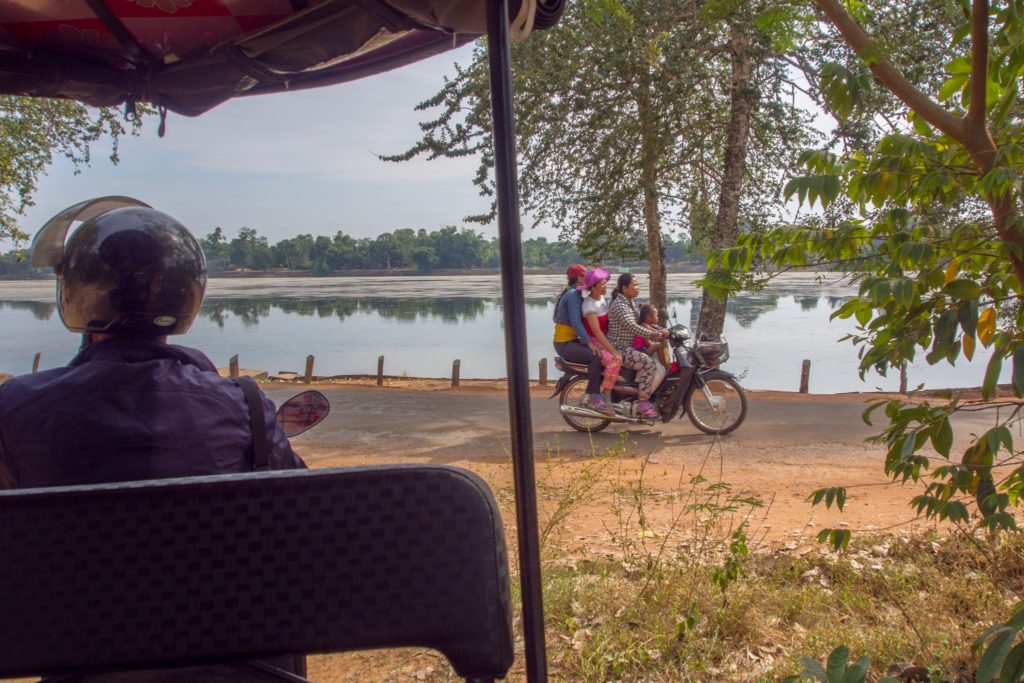
    whole family on a motorcycle

    We saw a lot of interesting sights from the back seat of our tuk tuk. The families on motorcycles especially amazed me. Back home a 250cc motorcycle would be considered under-powered, but here we could see entire families no one 125cc motorcycle.

    These candid photos are a bit different from my usual photos. Something I realized is that I missed focus on a lot of these pictures, I should’ve taken my time and focused on the subjects’ eyes. But then in taking my time I’d probably lose the candid feel of the photos. So I think I just need to continue to practice at getting faster at focusing but at the same time staying less noticeable.

  • om-d, om-g?!

    om-d, om-g?!

    It’s been a while since I’ve done a photography post. Apparently it’s been a year, since the last photography post on my blog appears to have been from November of last year. Man it’s crazy how fast time flies. It’s not that I haven’t been taking any pictures. I’ve just been too lazy to write lately. Last year I made a point out of trying to post at least once a week, but most months this year I barely even managed to crank out one post. So yeah, I’ve been lazy, but I will try to be more consistent in writing for the rest of the year.

    10403820_10152348845054302_2703984201377932272_o

    Anyways, a lot has changed since my last photography post. I ended up selling all my Pentax camera gear. It was a pretty tough decision. I’ve used Pentax SLR’s for over a half dozen years. I started with a Pentax K100d, then moved to a K20d, then finally a K-5. And I had a fairly decent collection of Pentax lenses too, covering from ultra wide to fairly long telephoto. I sold the entire collection on eBay.

    Chrome Legacy Window 11122014 21954 PM

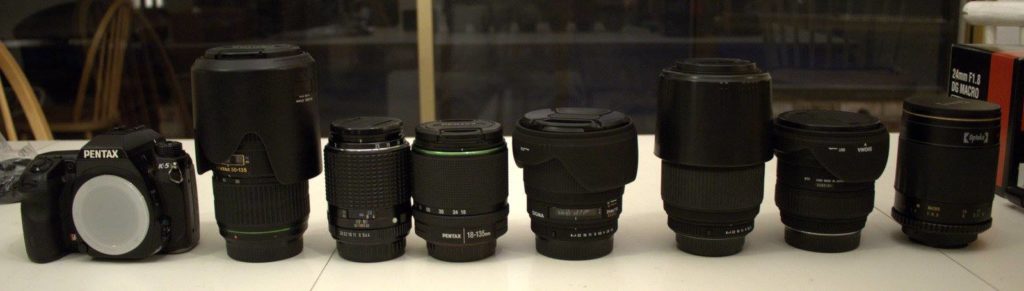
    I had thought about selling my Pentax collection a couple of years back, when I bought a full frame Nikon D600 during a holiday sale. On paper that Nikon was superior to my Pentax in just about every way that a camera could be superior, but I ended up sticking with Pentax that time. Strangely enough, the camera that got me to sell all my Pentax gear, the Olympus OM-D is actually quite worse on paper than the Pentax camera that I had.

    Chrome Legacy Window 11122014 23947 PM

    Although the specs are worse, the Olympus OM-D is a much smaller camera. Since most of my pictures are taken when I’m traveling or hiking I felt that having a smaller camera was worth the small tradeoff in performance.

    Compact Camera Meter - Google Chrome 11122014 24204 PM

    The size difference is especially noticeable when you’re looking at the camera from above with a lens attached. Because the OM-D is a mirrorless camera, the lens can sit very close to the sensor since there’s no need for space to clear a hinged mirror. And since the camera has a smaller sensor, the lenses can be designed smaller since they don’t need to cover as large an area. All this basically means is that there’s less weight on my shoulders when I hike and less space taken up in my bags when I travel.

    I’ve been using the camera for my last few trips and have found that I really don’t notice a difference in image quality, especially in good light. I was mostly worried about losing the ability to shoot in darker situations, but have found that it’s really not that much worse than my previous camera at the high ISO’s needed for those dark situations. ISO 1600 and even 3200 is still pretty usable, which is more or less where I was at with my old camera. The Nikon that I briefly owned was better of course, shooting at 6400 fairly cleanly, but for my purposes 3200 is plenty.

    Downloads

    These are a couple of shots I’ve taken in dark situations in the last few months. There’s some noise visible in the images, but for my purposes the noise is not too bad. Part of the reason why the camera’s so usable in low light is the amazing image stabilization system in the OM-D. The shot on the right was taken with a shutter speed of an entire second. That definitely would’ve been a blurry mess with my shaky hands on my old camera. With my old camera at a similar focal length of around 24mm equivalent the best I could do is maybe 1/6 of a second, and even then most of my shots at that shutter speed were too blurry to use. Now 1/6 of a second seems like no problem. This ability to use slow shutter speeds is good for dark situations, but it’ll also come in handy for stuff like waterfalls where I’d deliberately use slow shutter speeds to make the water look smoother. I might be able to get away without a tripod in more situations, which again means less weight on my shoulder and less space taken up by camera gear in my bag.

    Downloads1

    When hiking I often find myself in situations where I have a light foreground and dark background or vice versa, so it’s nice to have a camera with very good dynamic range. I was pretty spoiled with my old camera, it had amazing dynamic range, according to DxoMark it was among the best in this regard. The new camera is not quite as good, according to DxoMark it gives up almost two stops of range, and this is one of those areas where I actually notice a difference in the pictures. On my trusty old Pentax I bet I could’ve gotten more detail in both the bright areas and the shadows of both of these photos. But I’m happy enough with the pictures I got, and these sorts of photo situations seem to happen when the hiking is the hardest, in deep canyons or in forests, so I guess having a smaller and lighter camera is a fair trade.

    Downloads-001One unexpected bonus is the touchscreen. I honestly didn’t expect to use it much, but it actually comes in handy in a couple of situations. First, when I’m hiking I often hand off my camera to a stranger to have them take a picture for me. It’s much easier to explain to them to just touch on my face to take a picture than to explain that they should try and get the focus point in the viewfinder onto my face. So far since I’ve started using the OM-D I haven’t gotten an out of focus shot when handing off the camera to someone else. The second unexpected bonus is that the camera is still usable when your right hand is busted. With the cast I was wearing when I broke my hand I couldn’t wrap my finger around the shutter button of a traditional camera but I could tap the screen with my thumb to take pictures on my OM-D.

    Downloads12The touchscreen was a great bonus, but I’m not yet fully sold on all the tech on this camera. The OM-D has an electronic viewfinder rather than an optical one, which is nice when shooting directly into the sun. I can take my time to expose and frame carefully without worrying about burning my retina. And it’s nice to see exposure and depth of field in the viewfinder. But the electronic viewfinder is completely worthless in darkness. The first time I took my camera out backpacking the stars were pretty bright, so I wanted to get a picture of the big dipper over my sleeping bag. I found that I couldn’t see anything in the viewfinder, so I couldn’t focus and I couldn’t frame the shot. To make matters worse, you can’t focus when you can’t see since the couple of lenses that I have, since they’re all focus by wire lenses. It was only after an hour of guessing and testing, moving my camera slightly and moving the focus slightly that I was able to get a picture of the dipper.

    So yeah, there are times when I really miss having an optical viewfinder and mechanical manual focus lenses. I think with the OM-D I can get halfway there, I can buy a manual focus lens with distance markers, so I would at least be able to focus, but I still wouldn’t be able to see what I’m shooting at. I guess if I bought a really wide manual focus lens, I can just set the focus and point the camera in the general direction of what I’m shooting at and then crop to get the shot I want. But it’d be nice to not have to jump through all those hoops to get star shots.

    Aside from the star photography issues, I’m pretty happy with my OM-D and I don’t really have much regret in selling all my Pentax gear. Most of my Pentax gear was weather sealed, and I often shot in the rain or underneath waterfalls without worry. Supposedly the OM-D and the kit lens I’m using is sealed, so I guess time will tell if it holds up as well as my Pentax gear did in inclement weather.

    Over the years I became kind of a Pentax fanboy, I would always read up on all the latest Pentax news (it was actually easy cuz there really wasn’t much news, haha) and I was at times an avid contributor to Pentax forums. I can’t say that I’m a fanboy of Olympus or the OM-D series, I’m not OMG in love with the camera or the brand but it’s been good so far and I’m looking forward to a lot of travel and adventures with the camera. Who knows maybe I will someday be OMG in love with it.

  • healing progress

    healing progress

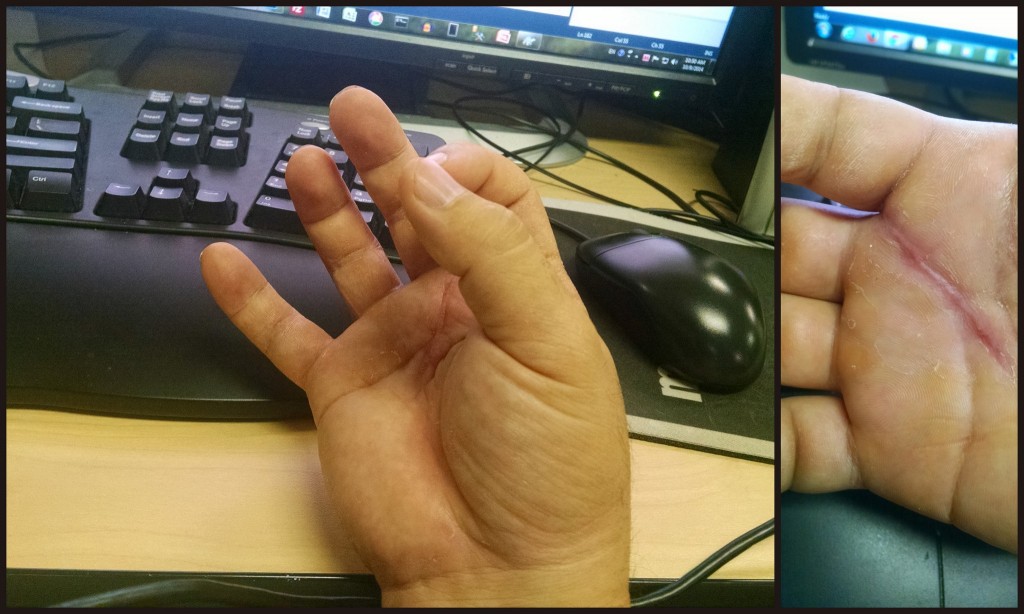
    It’s been about five weeks now since my crash.

    weekone

    For the first week after my crash I was in a hard splint that covered my arm all the way to my elbow. The timing of the crash was pretty terrible because I had agreed to be a groomsman for Jason’s wedding, which was the following week. I had a lot of road rash on my face, but by the time of the wedding the scabs had mostly fallen off, and the morning of the wedding I ended up picking off the rest of the scabs. And thankfully my suit (just barely) fit over the splint.

    weektwo

    The splint came off a few days after the wedding, about ten days after the crash. I was really glad to have it off, because my hand and arm was really itchy. It turns out my hand was itchy partially because the wound in my hand was still oozing. For the next week or so I had to change out the gauze and bandages over my hand daily. At about two and a half weeks after the crash the wound had healed enough for the doctors to take the stitches out of my hand. I wore a bit of gauze for a little while longer until they were confident that the wound was fully closed.

    now

    Fast forward to today– the wound is fully closed and the fracture in my hand is almost fully healed. I can wiggle my fingers and can touch my thumb to almost all my fingers, where even I week ago I couldn’t even touch my pointer to my thumb. But I can’t yet make a fist or completely straighten out my middle finger independently of my other fingers. Thankfully I haven’t gotten into a fist fight or felt the need to curse someone off this past month, and hopefully I’ll be able to do those things again soon (not that I ever really do those things…)

    For the first time since the crash I’m really starting to be able to use my right hand again. I’ve been able to hold a pen and make my signature with my right hand. I’ve been able to hold a fork in my hand, although a bit awkwardly still (and I’m still not able to use chopsticks.) I missed my car dearly, so thankfully there’s enough strength in my hand to hold the stick shift and start driving a manual transmission again. And thankfully for my work I’ve been able to type with both hands again, nearly doubling my productivity.

    personal

    I’ve been visiting the orthopedic department of the hospital and have been visiting with a physical therapist that specializes in the hand. Seeing x-rays of my hand and seeing the posters on the walls of the orthopedics department showing the complexity of the hand made me realize how amazing our hands are, and amazing our bodies as a whole are. And seeing the daily progress in my healing has made me realize the amazing ability of our body to heal itself.

    Seeing all this has made me remember the passage from Psalms about how we are “fearfully and wonderfully made.” Its something I guess I’ve taken for granted. I mean I’ve always known that our bodies were pretty complex, but seeing my hand go from completely nonfunctional to almost completely functioning again made me really realize how wonderful we are put together, and how wonderful it is that our body is able to put itself back together.

  • mercado de san miguel

    mercado de san miguel

    The Mercado de San Miguel is a food market located close to the Plaza Mayor in Madrid. When I travel I like to visit these sorts of markets. I’ve been to some of the famous ones, like the St Lawrence Market in Toronto and of course Pike’s Place in Seattle. Up until now my favorite has been the Nachsmarkt in Vienna, but it’s now been dethroned by the Mercado de San Miguel.

    OLYMPUS DIGITAL CAMERAThe mercado is built with glass walls all around, so you can see a lot of the awesome food from the street outside.

    OLYMPUS DIGITAL CAMERAThe market is quite crowded in the evenings, but it’s much quieter in the morning.

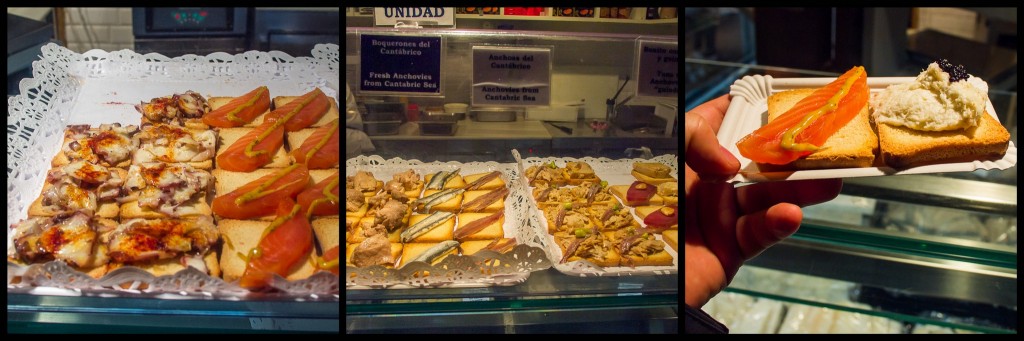
    fish-tapasThere were many different vendors, and it seemed like each had its own specialty. This one, for example, specialized in seafood tapas. The ones on the left are topped with octopus and salmon, in the middle there’s various anchovy tapas, monkfish liver, and tuna tapas. I tried one with salmon and one with crab salad topped with caviar. In hindsight I should’ve just tried all of them, but I especially regret not trying the monkfish liver. I’ve heard it described as “foie gras of the sea” and seeing as how I like foie gras (and don’t get to eat it often since it’s banned in California) I definitely regret not trying that one.

    OLYMPUS DIGITAL CAMERAThere is of course a vendor dedicated to Iberico ham. This guy slices it up for you and you can eat it right on the spot.

    drinks-olivesThere were also vendors dedicated to various beverages, like this one that had casks of different types of sherry, including a cask of amontillado (haha I wonder how many people would get that Edgar Allen Poe refernce…) I tried one glass of sherry (I forget which), one rebujito, which is a light sherry mixed with soda, and a glass of sangria. Each glass came with olives, which were the best tasting olives I’d ever had. I’d order drinks just to get the olives.

    OLYMPUS DIGITAL CAMERASpeaking of olives, they even had a vendor that pretty much just sold olives. In hindsight I should have tried some of these, even though they seemed pretty expensive. On the other hand, paying for olives doesn’t seem like a hot deal when I can buy a drink and get olives for free…

    IMGP5225There was paella, of course, but I decided not to try any, since our next stop would be Barcelona. I figured paella would be better there since it’s on the coast. And also I figured freshly made paella would be better.

    octopus-urchinThese were probably my favorite. On the left is an octopus salad. It seemed pretty simple to make, I might have to try making it, if I can find somewhere to buy fresh octopus. It’s just boiled octopus with a bit of bell peppers and red onion, with a sprinkling of sea salt and a drizzling of olive oil. I think the difficulty for me would be in finding good fresh octopus and cooking it so that it’s tender. My other favorite was stuffed urchin. This I have no clue how to go about making. Next to the urchin is a tortilla espanola, which is basically a potato and egg frittata.

    We ended up eating at the Mercado de San Miguel a few times in the couple of days we had in Madrid. It was definitely one of the biggest highlights of the trip for me.

Posts

Categories