Category: working world

  • my first marketplace extension

    my first marketplace extension

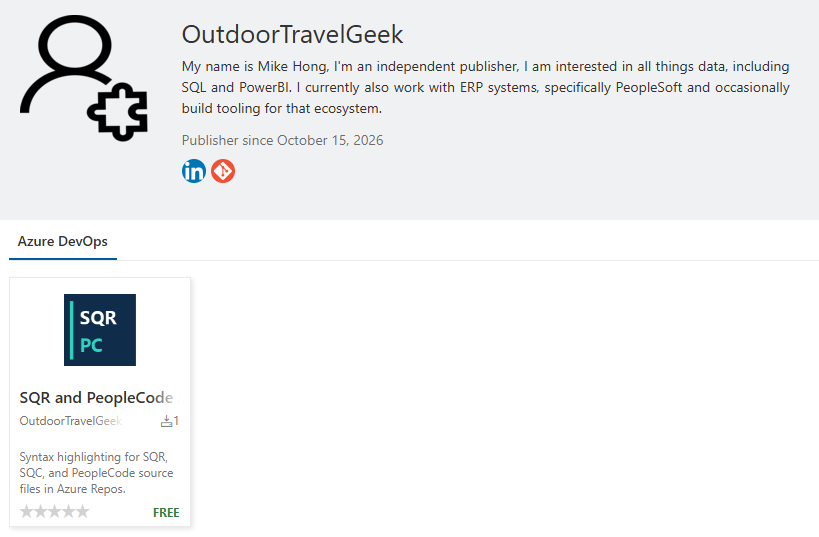
    So I published my first extension to the Microsoft Visual Studio Marketplace this morning. It’s an Azure DevOps extension that adds syntax highlighting for SQR and PeopleCode files, which is probably only interesting to a fairly small group of people who work with PeopleSoft. But I’m pretty happy with it, partly because it makes reviewing code a little easier, and partly because I went from an idea to a publicly available extension in a single morning.

    For those who don’t spend their days looking at source code, syntax highlighting is what gives different parts of a program different colors. Comments, keywords, strings and variables are easier to pick out when you’re reading through a file. It’s something you get used to having in a code editor, and you notice pretty quickly when it’s missing. I wanted that for SQR and PeopleCode in Azure DevOps, so I figured I’d see whether Codex could help me put something together.

    To be honest, without AI I probably would never have bothered. I’d have needed to learn how Azure DevOps extensions work, figure out how to define the highlighting rules, learn how to package the extension, and then work through the whole publisher registration process. None of that is beyond me, but it’s a fair amount of time to spend just to get some colors in a code review. It’s the sort of thing I’d think would be nice to have and then never actually get around to doing.

    I gave Codex a link to Microsoft’s extension documentation, an existing Marketplace extension that did something similar for another language, and a couple of GitHub repositories with SQR and PeopleCode support for VS Code. From there it worked through the extension format and created the code, build scripts, documentation and tests. Apparently the VS Code highlighting definitions couldn’t just be dropped into an Azure DevOps extension, so there was some work involved in creating the right definitions. Thankfully I didn’t have to spend the morning figuring that part out myself.

    There was a little back and forth as I worked through the release process. I registered as a publisher under outdoortravelgeek, updated the publisher setting, and had Codex rebuild the package. One useful thing it caught was that I’d edited a generated manifest, so my change would have been overwritten the next time I built it. Once that was sorted out I installed the extension in Azure DevOps and tried it. It worked well, so I asked Codex to set it to public and create a new version, which I then published to the Marketplace. The project also has 17 passing automated tests, though seeing it actually work in Azure DevOps was the part I was most interested in.

    I guess this is what people mean by vibe coding. I described what I wanted, gave it some references, and worked through the results with it. I still went through the registration and publishing steps and tested what it produced, but having help with the unfamiliar parts made the whole thing easy enough to finish while I was still interested in doing it. By the end of the morning I had a publisher account and an extension that other people could install.

    Anyways, if you work with SQR or PeopleCode in Azure DevOps, hopefully you’ll find it useful. It’s a pretty small contribution to the world of software, but it’s my first published Marketplace extension, and I’m glad I finally made one. There are probably a lot more little projects like this that I’d actually get around to doing now.

  • Smarter SMART with AI

    I posted this article on my LinkedIn profile recently. I used to think moving into management meant giving up the part of my career I loved most, building cool things. Over time, I realized leadership is just another form of building. And surprisingly, AI has become one of the tools that’s helped me make that transition. Here’s what I learned…

    Smarter SMART with AI, and Finding Joy in Helping Others Build

    One of the greatest privileges of my career has been occupying a unique space within technology organizations: being trusted enough by CIOs, CTOs, COOs, directors and executive leadership to help shape modernization strategy, while still remaining close enough to the work to personally build and deliver solutions.

    There’s something deeply satisfying about taking an idea from a whiteboard discussion to a proof of concept, evolving it into a minimum viable product, and ultimately deploying it into production where people rely on it every day. Watching an idea become a real solution has always felt like a win.

    Over the past decade, I’ve been fortunate to help lead and deliver several initiatives that began as executive conversations and ultimately became enterprise solutions. These include modernizing the California Department of Education’s DataQuest reporting platform, modernizing data platforms for the San Diego County Employees Retirement Association and the California Department of Managed Health Care, and developing a legal document search platform for the DMHC. Each started with a vision presented to executive leadership, and I had the opportunity to help execute that vision from concept through production.

    For many years I hesitated to pursue higher leadership positions because I knew it would mean fewer opportunities to build software and more time spent in meetings, planning sessions, budgets, and personnel management. I’ve always loved learning new technologies and creating systems that solve real problems. As my responsibilities grew, I had to accept that my role would gradually shift from being the primary builder to enabling others to build.

    That transition changed my perspective on management.

    Performance evaluations, for example, can easily become a compliance exercise. This is especially true in unionized environments where ratings often have little direct impact on compensation. (But that is a spiel for another day). Rather than viewing them as another administrative requirement, I wanted them to become meaningful conversations grounded in measurable accomplishments and focused on future growth. I also wanted employee goals to truly be SMART: specific, measurable, achievable, relevant, and time-bound.

    The challenge was measurement.

    Over the past year, one of my team’s modernization efforts has been implementing a contemporary project management platform, documentation repository, and source code management environment. While this created a wealth of operational data, transforming that information into meaningful insights remained difficult.

    This is where AI, specifically ChatGPT Codex, became an unexpected leadership tool. Using Codex, I quickly developed reports that summarized project contributions, technical accomplishments, documentation, and development activity. Those reports provided objective evidence that helped me write more thoughtful performance evaluations and establish meaningful SMART goals for each team member.

    Out of curiosity, I even experimented with having AI draft entire evaluations. Technically, it worked remarkably well. It populated our PDF evaluation forms correctly. But something was missing. It didn’t sound like me. Technology can summarize accomplishments, identify patterns, and save hours of administrative work. What it can’t replace is the human understanding of a person’s growth, character, resilience, and potential.

    In the end, AI didn’t replace my judgment, it amplified it. By reducing the time spent gathering evidence, it allowed me to spend more time on the part that actually matters: recognizing achievements, providing meaningful feedback, and helping people grow.

    Looking back, I realize that my definition of “building” has changed.

    Earlier in my career, the greatest satisfaction came from delivering production systems. Today, I still enjoy creating solutions, but I find equal satisfaction in helping shape strategy, equipping my team with better tools, and watching them deliver outstanding work.

    Perhaps that’s one of the more rewarding transitions in leadership: realizing that success is no longer measured only by what you build yourself, but by what you enable others to build.

  • dating data reporting

    I’ve been working in the Data Reporting Office of the California Department of Education for about a year now. The logical and analytical left brain part of me enjoys the challenge of writing SQL statements (SQL is a database programming language) to extract the data needed for reports. The end result of my work is mostly reports filled with numbers. It actually sounds kind of boring when I describe it this way.

    In general I like to do things that tell stories. I think that’s the creative right brain part of me. I like to take photographs and write on this blog, both of which are inherently methods of story telling. I think that’s why after a year in my job I’m still not bored– My work requires logic, but it also tells a story, albeit in a slightly different way. The numbers in the reports I generate tell the story about the successes and failures of education in California. For example, there’s a lot of interest in English learner students in California, and a data set I worked with recently seems to tell the story about how our state is failing to educate these kids– many of them never achieve English fluency.

    On a completely unrelated note, it seems like there’s a lot of interest in my dating life (or actually the lack thereof). So I’ll try to tell the story of it. Unfortunately the usual modes of story telling don’t apply here. I don’t really have any interesting anecdotes to write about, and I don’t take pictures on dates (that would be awkward). But I’ve been on my fair share of first dates, so I suppose there’s enough data and numbers to tell some sort of story about my successes or failures. So that’s what I’ll do. I’ll try write down any statistics I could think of– hopefully at the very least it’s an interesting story.

    Let’s start with some big picture numbers. I’ll start with cost, since that one’s easy. I am currently on 4 dating apps– Match, eHarmony, Coffee Meets Bagel, and okCupid. Coffee Meets Bagel has costed me the least amount of money, a grand total of ZERO dollars. okCupid is free too, but I spent $9.99 for one month of their premium service, mostly out of curiosity, which I’ll explain later on. For both Match and eHarmony I’ve spent about $240 each. Interestingly enough I started both of them about the same time and I initially bought a six month subscription with each of them for around $120. I forgot to cancel both of them, and now I am about a third of the way through my second six month subscription with both. The total cost for each has worked out to about $20 per month.

    In terms of bang for the buck, Coffee Meets Bagel (I’ll call it CMB since I’m tired of typing it out) has been the best for me. (That’s kind of a misnomer– there’s not actually any banging going on, neither literally or metaphorically.) CMB costs the least amount of money yet it has gotten me the most connections. The way CMB works is that you are matched with one profile every day, which you can either like or pass. If your match likes you as well, you are connected and can communicate through their messaging system. On a typical month I seem to connect with two or three matches, though not all of them will lead to first dates.

    Next in effectiveness for me has been eHarmony. Like with CMB there’s some sort of matching algorithm which selects profiles for you to see. It’s slightly less structured than CMB because instead of needing a mutual like to initiate communication, either side can start the conversation by sending questions. In eight months I’ve gone on three dates matched through eHarmony.

    I’ve had little to no success with Match and okCupid, mostly because of apathy on my part. With Match and okCupid you browse profiles and send messages to the people you are interested in. I find that it doesn’t work well for me. It takes a lot of messages to get a response, and even when I do get a few messages going back and forth none have ended with a date. So lately I haven’t been using either of these apps much.

    Actually, now that I think about it, there’s an additional matching “app,” though it’s not a website and doesn’t exist on a smartphone. It’s my family. In terms of dates per dollar it’s actually the most effective, being the only one that’s actually been a financial gain. (My aunt in Korea actually gave me money to go on a blind date.) In terms of number of first dates it ranks pretty highly too, about on par with eHarmony.

    I’m not sure if my results are typical. I have friends who have had success with both Match and okCupid, so my results there are probably not typical. But I’ve heard from several friends that CMB seems to work well for them, and I know of several married couples who have met on eHarmony, so in general it seems like within my circle of friends I’m fairly in typical in leaning towards CMB and eHarmony. In terms of match rate or number of first dates I have no idea if my results are typical, though if I had to guess I’d say they’re probably lower than average. All of the dating apps have a way of selecting preferences for matches, and in these preferences I am very selective which most likely severely lowers the number of potential first dates.

    The reports I generate at work are typically aggregated or filtered based on several demographics– typically gender, race, age (or more likely grade), location (typically county or school district) and subgroup (typically these include demographic information like if a student is homeless or a foster child.) Similarly with these dating apps I filter my matches based on gender (females only please), race (Asian or Pacific Islander), age (25-35), location (typically just far enough to include the Bay Area) and subgroup (typically it’s Christian, never married, no kids currently, non smoker).

    I don’t have any hard data on this, but I’m fairly certain my stringent preferences shrink the potential number of first dates significantly. The only thing I have resembling a statistic comes from okCupid. I briefly mentioned earlier that I paid $10 for a month of premium on okCupid, which they call A-List. okCupid lets you ‘like’ a profile. You can see a list at any time of the profiles you’ve liked, every single one of them fit the demographics I mentioned earlier, i.e. Asian girl between the ages of 25-35. It also shows you mutual likes for free. At the time (this was several months ago) I had liked a few dozen profiles but had only a single mutual like. I had twenty people who had liked my profile. If you pay for A-list you can see who likes you, so out of curiosity I paid for one month. Something like 95% of the people who had liked me were either white, black or Latino, the one mutual like was the only Asian who had liked me. I guess that’s the (dating) story of my life. The girls I like are not interested in me, and the girls that like me are the ones I’m not interested in…

    Anyways, now we get to the heart of the report, the numbers. The numbers will basically be about whatever I feel like. Like my work reports the numbers will be broken down by demographics. We’ll ignore gender since they’re all female, race will mostly be either Korean or Chinese. I won’t report on age or subgroup (or like we say at work, that data is redacted). Location will basically be Sacramento or other. The numbers are mostly from memory so they may be off by one or two, and if you try to sum up the numbers you won’t get any meaningful result due to missing data (this often happens with work reports too), but hopefully the numbers tell an interesting story.

    Here we go.

    Out of 3 Korean girls that I met for first dates in the greater Sacramento area, 100% were through CMB. 100% were at purveyors of caffeine. Out of those, 2 were at Starbucks, 1 was at a boba place. Only 1 of those went beyond a first date, the 1 that was NOT Starbucks. Clearly Coffee Meets Bagel should not be taken literally…

    Out of 4 Korean girls that I met for first dates outside of the greater Sacramento area but within the US, 25% were from CMB, 25% were from eHarmony and 50% were from family. One date was at a purveyor of caffeine (Starbucks). Out of the original 4 a total of 50% forgot to bring their wallet. Out of those that forgot to bring their wallet I thought 100% of them were really cute. Sadly out of those cute forgetful girls 0% went past a first date.

    Out of 4 Chinese girls that I met for first dates outside of the greater Sacramento area 50% were from eHarmony and 50% from CMB. 0% forgot to bring their wallet. Out of the original 4 a total of 50% were grad students at UC Berkeley. Out of the original 4 a total of 50% of the time I went on the first date with a bicycle on my car. Out of those I actually only rode my bicycle on the date 50% of the time. Out of the original 4 only 1 was at a purveyor of caffeine (Philz!)

    Out of 2 Chinese girls and 1 Japanese girl I met in the greater Sacramento area 100% were through CMB. 100% were in the medical field yet 0% were doctors. Two were at purveyors of caffeine and one was at a purveyor of beer (is there anything to do in Sac for a first date besides coffee or beer?) 0% forgot to bring their wallet.

    Out of 7 blind dates that my family has tried to set me up on, 100% have been Korean. Three of them were located in Korea, two were in California, one in New York, and one in Seattle. I have gone on 100% of the ones in California, 33% of the ones in Korea, and 0% of the ones in Seattle and New York.

    The farthest date from home was the one in Korea, over 5,000 miles away, which was organized by family. The farthest that was not organized by family was nearly 2,400 miles away in Washington DC, initially met through eHarmony.

    The most expensive date I can remember was nearly $200, though that wasn’t a first date. It consisted of dinner and musical tickets. The most expensive first date I can remember was around $20, which was two cheap entrees at a Chinese restaurant. The cheapest first date was closer to $2, one small coffee at Starbucks for myself (she paid for her own, obviously she didn’t forget her wallet). Maybe I shouldn’t cheap out so much on first dates…

    If I tried harder I could probably come up with more statistics, but I’ll stop here. In hindsight my dating life isn’t all that interesting, maybe someday I’ll have an interesting anecdote to share instead of these boring numbers.

  • the POST finale

    Today was my last day with the California Commission on Peace Officer Standards and Training, or POST as it’s known internally. On Monday I’ll be starting a new job at the California Department of Education.

    My final day at POST was like most endings in my life so far– anticlimactic. I spent the early part of the day filling out my exit paperwork, then I spent a few hours wandering around shaking hands and saying goodbye to the people I’ve worked with. That’s probably what I’ll miss most about this job, the people. Because it’s such a small organization it’s almost like an extended family.

    The work itself I won’t miss too much– Initially I really enjoyed it, and it was something that I wanted to try my hand at. I was hired on as a web developer, and because the agency is pretty small I was able to do a variety of things as a web developer, from graphics design to database administration to programming and even some photography. At least that’s how it was initially. But towards the end of my time there I was almost a pure programmer/developer, which I found I didn’t enjoy as much. I found that I enjoyed working with databases, and so I’m fortunate that I was able to find a job that works with data more. Starting on Monday I’ll be working in the data reporting office of the CA Department of Education.

    I’m fortunate that I found a new boss that was willing to take a chance on hiring me as a database/report developer, even though I don’t have a whole lot of experience with databases or data reporting. And I’m fortunate that four years ago I found a boss that was willing to take a chance on hiring me even though I didn’t have a whole lot of experience in web development. Looking back I realize that I’ve been blessed in my career– I’ve always been blessed with great managers, and I’ve always been blessed in being able to find a job in something that interests me, even though I might not have all the qualifications on paper. I’ve found that what I like most is learning, and I’m lucky that every job I’ve had has been a great learning experience, even though sometimes I learn what I don’t like doing.

  • kid’s day

    kid’s day

    Today my work had it’s annual kid’s day. This was my first time seeing it, since I was out on vacation last year. I was expecting it to be super boring, just a bunch of bored kids sitting in their parent’s cubicle. Instead I found that my work has just about the most awesome kid’s day imaginable. My work deals with a lot of law enforcement agencies, so they were able to bring in some local agencies to do demonstrations for the kids.

    Folsom PD brought in their mounted horse unit. One thing I learned. Don’t stand behind a horse. It smells back there…

    The Sheriff’s department brought in their bomb robot.

    The SWAT team even brought in their armored truck.

    The K9 unit brought in two of their dogs, a German shepherd and a Dutch shepherd. I’ve always been scared to get near a K9 police unit, but found that the dogs were super friendly. They couldn’t do any of the normal tricks, like shake hands or roll over, but that’s totally fine because they can do awesome tricks like take down suspects and sniff out drugs.

    I was by far the biggest kid there, but I still had a ton of fun.

    Things I’m thankful for:

    • Law Enforcement Officers– The men and women who put their lives at stake for public safety.
    • My job. Sometimes I think it’s really boring (well actually it is, because I’m just a computer geek)– but at least the agency I work with does some cool and useful stuff.
  • twelve pounds

    twelve pounds

    My work has a holiday tradition called the twelve pounds of Christmas. For twelve days there’s a potluck every work day leading up to Christmas, except for one day off for the annual holiday party (which is a buffet.)

    My work is organized into different bureaus, and each day a bureau brings in food for the entire office. So basically you bring food in one day and chow down for the rest of the days. For some reason this year it seems almost like a competition, with each bureau trying to outdo each other.

    The potlucks used to be held in the upstairs meeting room, but for some reason this year they moved them to the downstairs meeting room, which is at most ten feet from my cubicle. Willpower comes a lot easier when you have to climb a flight of stairs to see the food. This year the food is basically in front of my face, and I can constantly smell it, so willpower is in short supply.

    Yet somehow, up until this week I was able to stay away, just nibbling here and there. But on Monday things changed when the potluck got cranked up another notch. Somebody started cooking bacon in the meeting room. The smell and sound of sizzling bacon was intoxicating. They should have laws against cooking bacon in the office because I’m pretty sure productivity drops to zero when the aroma of cooked bacon wafts through the office.

    Today things got even crazier. Somebody brought a chocolate fountain in. Best invention ever. I started off slowly, eating a few pieces of fruit dipped in chocolate. But later somebody brought in doughnuts, marshmallows and rice krispy squares. “I’m already in this, might as well go big…” I thought, as I drenched a doughnut in chocolatey goodness.

    I guess by go big, I meant stomach go big.

  • identity crisis

    identity crisis

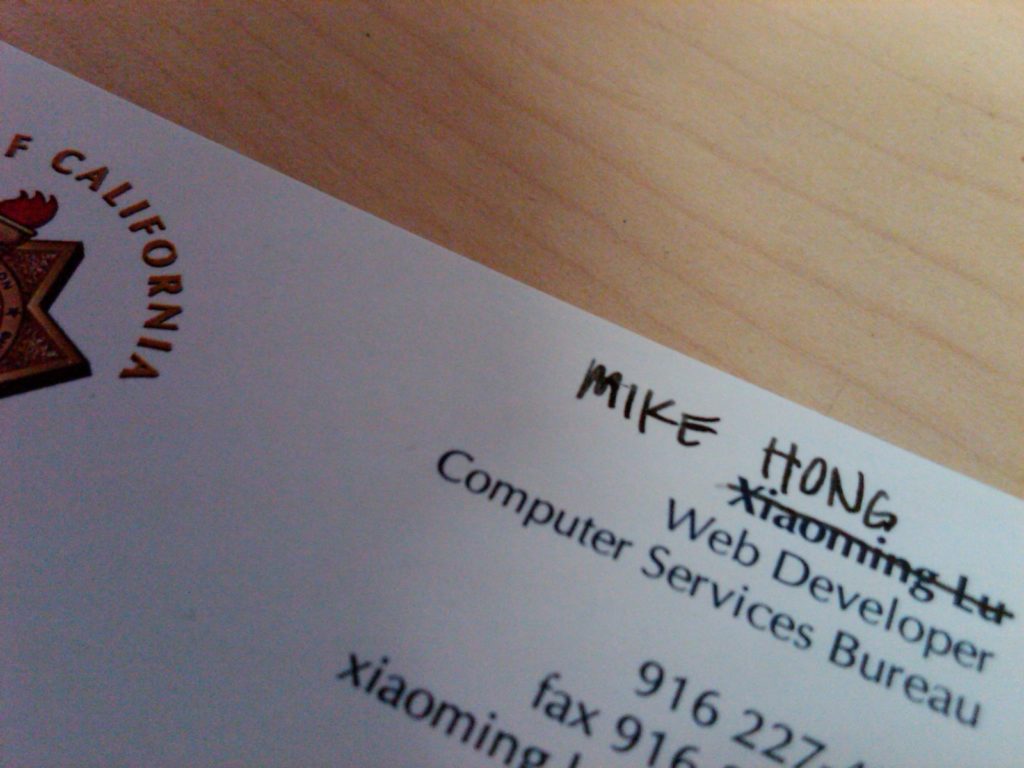
    It’s hard to believe that I’ve been at my job for six months already. To mark this momentous occasion I ordered business cards. It seems kind of wasteful because I have a box full of business cards from the previous person who had my position. The position is the same, as well as the phone number and fax number, so technically I could just cross out the name and email address and use them. And in truth I don’t really meet with external customers often, so I wouldn’t really hand them out often.

    I left my old job because I wanted to get away from technical support and server administration and do something more mentally stimulating. My job at CalPERS was cool and all, and the people and facilities were awesome, but it wasn’t all that interesting to me. At times it felt like a glorified version of Geek Squad. There were some days when all I did was stupid stuff like replace keyboards and tell the user to reboot the computer (that fixes 90% of computer problems).

    I wanted to try my hand at web development, since I did it on and off as a hobby. But since I didn’t have much actual work experience in it, except for one summer internship during college, I didn’t get much response from employers. So I was pretty blessed to get my job here. Not only did they hire me without much work experience, they paid to send me to training. I guess I should have been more thankful, but I was greedy, already thinking about the next step in the career ladder. I didn’t expect to stay at this job long, I planned to just stay until I found another job that paid higher somewhere else.

    Looking back, all the jobs I’ve had have been a blessing. I’ve had some pretty awesome ones. The first job I had right out of high school was as a video game tester, a dream job for almost any guy. I can honestly say that I’ve never had a crappy job. I didn’t really realize that until I looked back and thought about all my blessings.

    We are all blessed in many ways, but we often don’t realize it. Instead we are greedy, always wanting more, never content with what we have. I think a lot of our life is controlled by our attitude. I read this quote this morning that sums up what I’m trying to say better than I could have.

    The longer I live, the more I realize the impact of attitude on life. Attitude, to me, is more important than facts. It is more important than the past, the education, the money, than circumstances, than failure, than successes, than what other people think or say or do. It is more important than appearance, giftedness or skill. It will make or break a company… a church… a home. The remarkable thing is we have a choice everyday regarding the attitude we will embrace for that day. We cannot change our past… we cannot change the fact that people will act in a certain way. We cannot change the inevitable. The only thing we can do is play on the one string we have, and that is our attitude. I am convinced that life is 10% what happens to me and 90% of how I react to it. And so it is with you… we are in charge of our Attitudes.
    -Charles Swindoll

    And so I guess that leaves us with a sort of identity crisis. Do we want to be known as a cynical, negative person? Or do we want to be positive, upbeat and encouraging? We have that choice each day.

  • fist bumps

    fist bumps

    Our friendship started off in probably the worst possible way. I think it was my first or second month on the job. It could have been a hangover or it could have been some spoiled leftovers that left my stomach feeling queasy that morning, I don’t remember. But I do remember having the sudden urge to puke. I made it all the way to the bathroom, but didn’t quite make it to the stall, throwing up in the last sink before the toilets and clogging it completely.

    I decided to be responsible and notified facilities. A little while later I had to go to the bathroom again and saw the janitor cleaning up my mess. I remember feeling really bad about the mess and apologizing to the janitor. He gave me a fist bump and said,  “Don’t worry about it, hope you feel better.”  Over the next two and a half years, whenever we passed each other in the vast hallways at CalPERS, he would greet me with a fist bump.

    It’s funny how sometimes you don’t need to say much to be encouraging. Sure we would talk sometimes, about weekend plans, or about the weather, typical small talk stuff. But what really spoke to me was that almost daily fist bump. It encouraged me to have a better attitude towards work, to be more cheerful and thankful.

    Today was my last day at CalPERS.  To the many people who I’ve worked with and learned from over the years I sent an email thanking them. To a handful of people I shook their hands and said farewell in person. To Alejandro it was one last fist bump, a handshake, and a thanks.

Posts

Categories